Welcome to the thrilling conclusion of my two-part series, Illogical Phalluses, where I explore some of the flawed logic common in red-pilled, misogynistic, manosphere spaces.
In Part 1, I examined three widespread misogynistic claims and the logical fallacies used to support them. Here in Part 2, we’ll shift the focus to three rhetorical fallacies often used by men when defending those ideas in the face of pushback and criticism: ad hominem, whataboutism, and appeals to futility.
But this series isn’t just about calling out bad logic, it’s also about helping us all grow. My ultimate goal is to help people – especially men – recognize these patterns, unlearn harmful habits, and choose to do better every day. That’s why, after breaking down each fallacy, I’ll also offer some reflections on how we can respond more thoughtfully and contribute to better, healthier, and more productive patterns of communicating and relating moving forward.
Let’s jump right in!
Ad Hominem
Ad Hominem is probably one of the most common tactics used in far too many discourses today. The phrase is Latin for “to/against a person,” and this happens when someone attacks the speaker’s character or personal qualities in their attempt to hurt or divert from their argument. Examples of this fallacy are EVERYWHERE — not just in manosphere spaces. I’ll share some general examples, as well as some directed at me personally on Threads.
Against other male critics who promote healthy masculinity, misogynistic ad hominem attacks often have to do with “feminizing” the speaker, and may sound like:
- “Bro, you’re clearly a beta simp who’s never been with a real woman.”
Instead of engaging with a critique of toxic masculinity, it attacks the person’s sexual experience. - “Only weak men defend feminism.”
Equates supporting gender equality with personal weakness. - “You sound like someone who’s been friend-zoned your whole life.”
Dismisses criticism by implying it stems from the speaker being bitter or sexually frustrated. - “Enjoy being a cuck while your girl sleeps with a real man.”
Common insult used when a man advocates for mutual respect, or challenges the ‘alpha male’ mindset. - “You’ve got single-mom energy.”
Used to feminize or insult men who express empathy or emotional nuance.
Looking for some real-life examples? Check out the following personal interactions I’ve had on Threads. I’ll be honest, I was a bit torn about whether to hide the usernames or not. On the one hand, the individual is not important here — what’s important is to familiarize ourselves with the same tired patterns men engage in to avoid self-reflection and accountability, to deflect the conversation, to bait you into an emotional response, and do everything they can to avoid having to face an uncomfortable truth about themselves. On the other hand, men have long enjoyed protection from consequences, and it doesn’t feel right to continue that pattern. So, in the end, I decided to hide the usernames of the women in order to try and protect them from further abuse, and left the usernames of the men intact as a heads up to anyone who may come across them, and an invitation to report and block these accounts as needed. As always, I’m open to any feedback on this choice.
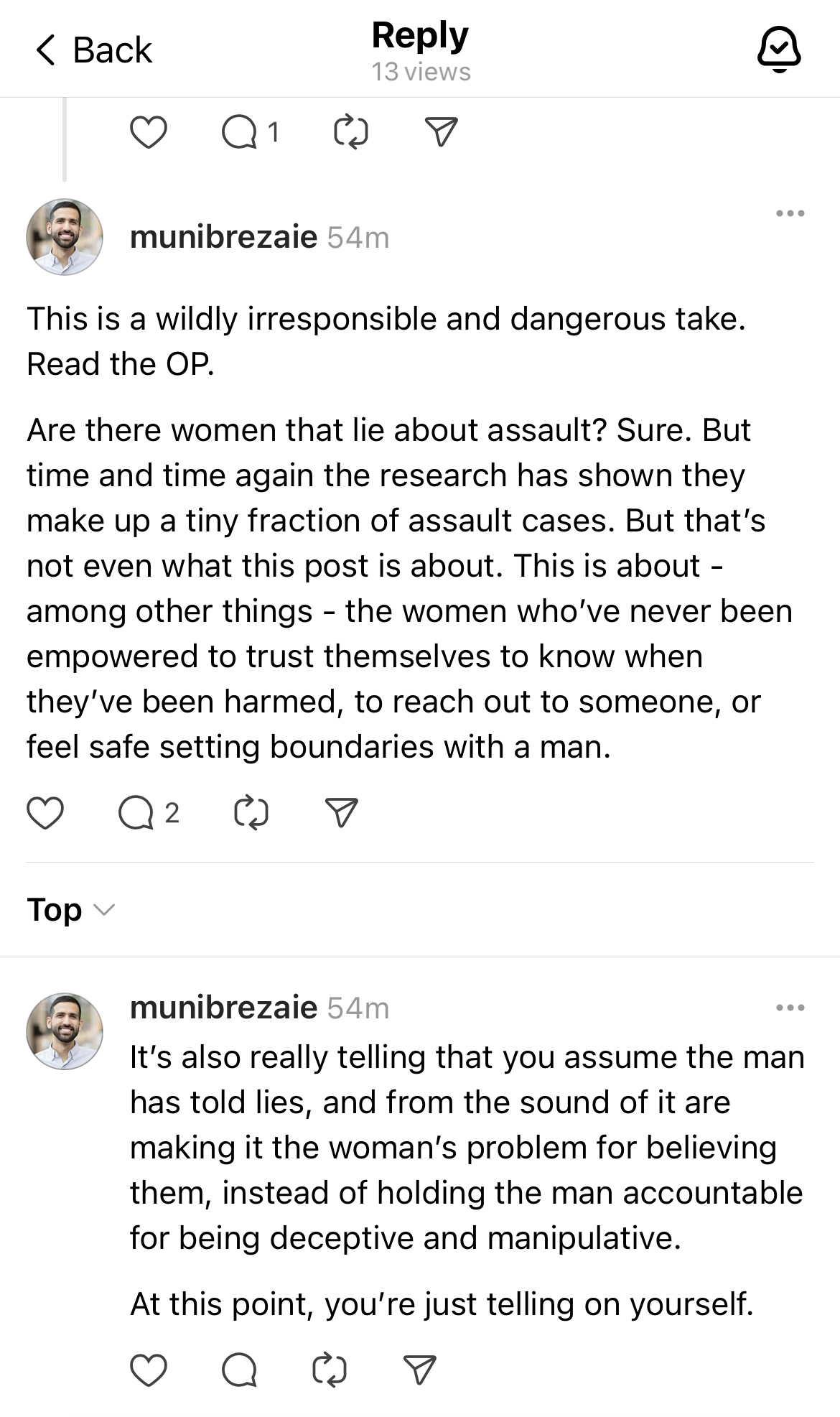
In this first example, I pushed back on a man’s ridiculous response to someone’s original post about the normalization of sexual assault. I reinforce the original post’s statement, and attempt to call out some of the harmfulness of his reply. As you can see, his immediate response was ad hominem. He memed my profile picture into the joker and accused me of molesting not only my own children, but all of the children at the school I work in.

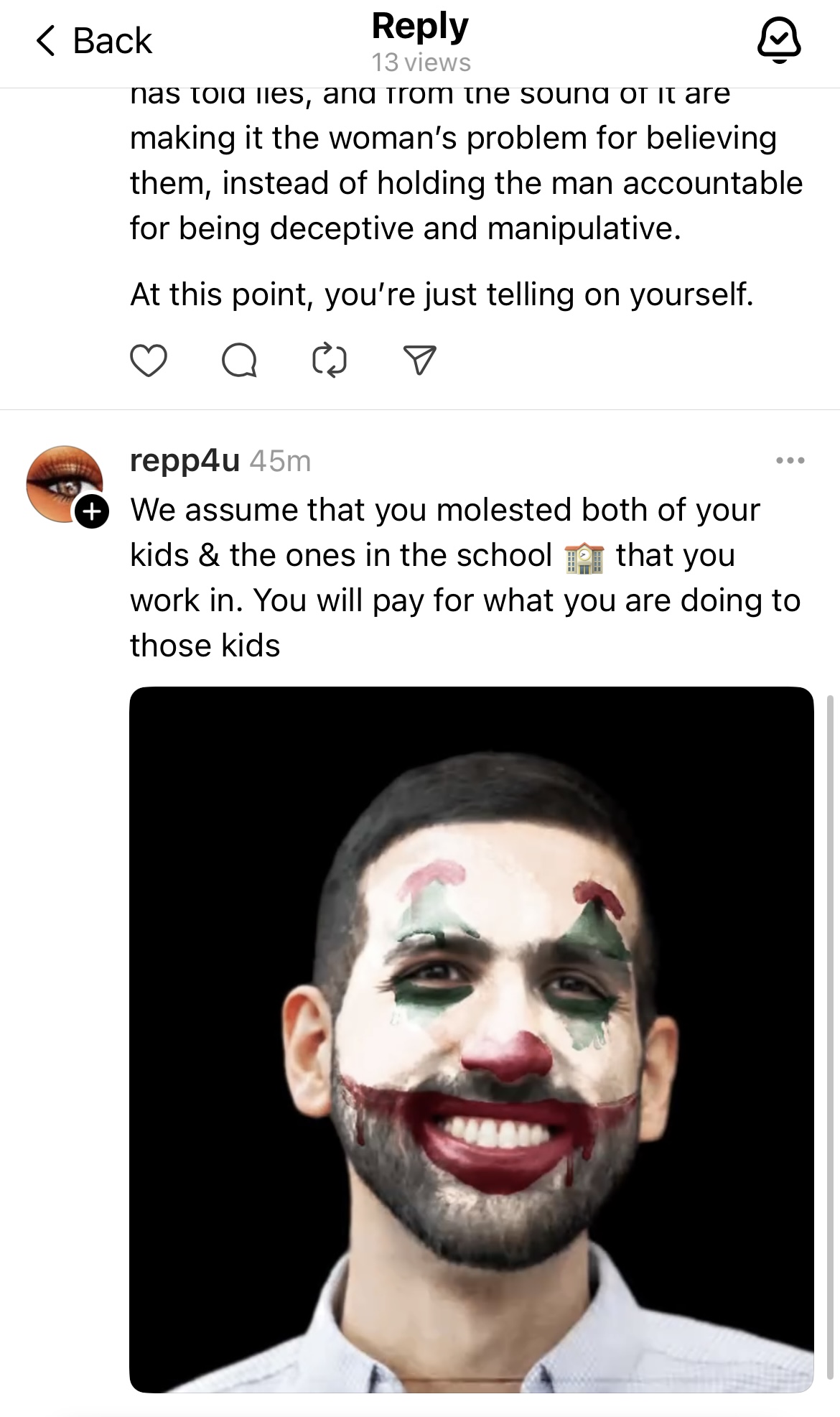
In the second example, someone posted about the injustice of our justice system, and how men are more likely to get longer sentences for damaging property than for raping a woman. A man comes into the comments and says “in the end it’s just two types of damaged property.” After I call out the harmfulness of the statement and the need to support women, he came back with an ad hominem response, sprinkled with another classic misogynistic defense: “relax, it’s just a joke!”
“Stand up for women? Nah I ain a simp lol learn a sense of humor since you clearly knew it was a joke.”

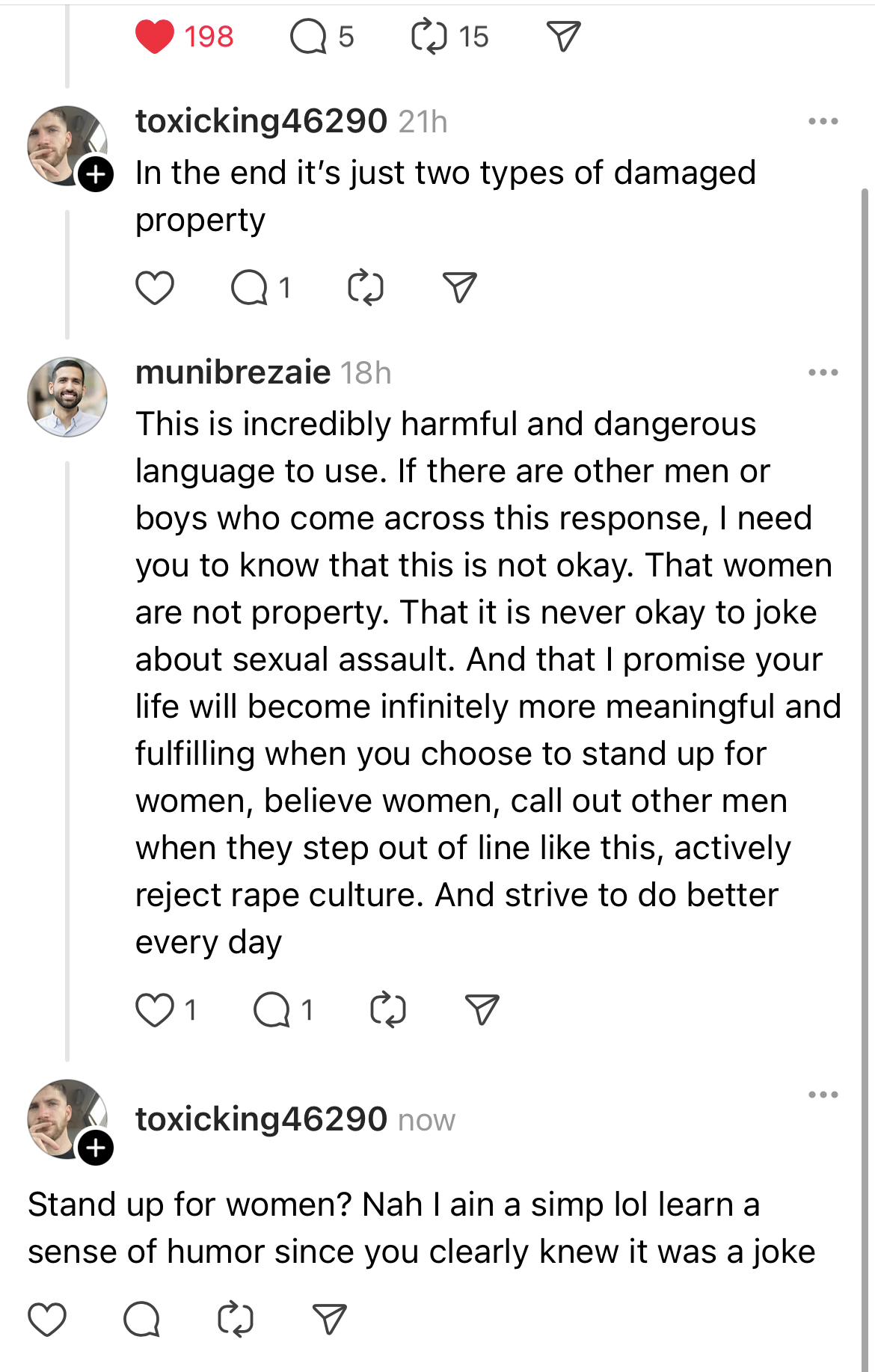
The fallacies are literally dripping from every word: personal attack in calling me a “simp,” and additional deflection of saying it was “clearly” a joke. Extra points for putting the fault on me for being the one without a sense of humor.
One last example from my personal files. In a recent post, I expressed how amazing I think it is that there are so many women who don’t actually mean “all men” when they talk about the very real problems created by many men. A man’s response:
“Oh for fuck sakes grow a set. They fucking hate you, they aren’t going to touch it just because you said what you were told to say ya weak coward. Jesus that’s pathetic”
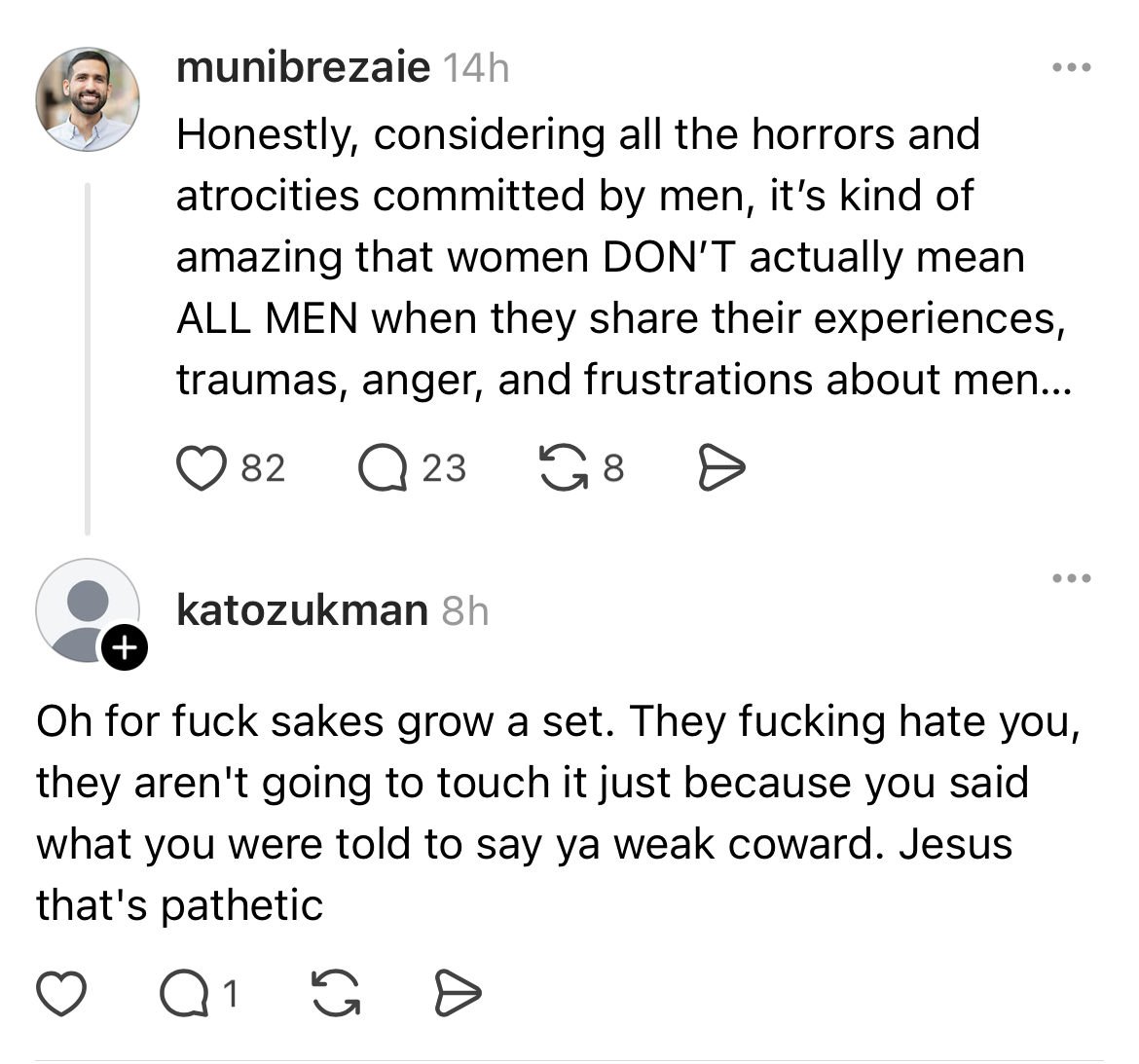
He attacks my gender/sexuality/masculinity with “grow a set,” tries to make it into an “us vs them” thing by saying women hate me for being a man, suggests I’m only saying something positive about women in the hopes that one of them will “touch it” – with the ‘it’ here presumably being my penis, and wraps it all up by calling me weak, cowardly, and pathetic. Not one moment of reflection or attempt at real engagement with my statement.
A man who says “they aren’t going to touch it because of what you said” is a man who likely tried to get a woman to touch him by saying something he thought she might like to hear. A man who attacks another man’s lack of sexual experience, is a man whose self-worth is likely tied up in a gross form of masculinity where “being a man” means having sex with as many women as possible, and feels like a failure according to his own self-fabricated metrics.
This pattern is predictable and boring, but sadly often effective. It attempts to draw out an emotional response, hoping that you’ll change the subject as you try to defend your character. Men who respond in the ways above rarely bring much substance to the issues, take little to no time to reflect on what they actually stand for, are often extremely insecure about their own masculinity, are easily threatened by any woman who speaks up, and are constantly projecting their own framework onto others.
Women who dare challenge such men get similar attacks, but often with a much more disturbing and violent bend to them, including threats of rape and murder, and calls for suicide. Some examples of common ad hominem attacks on women include:
- “You hit the wall and now you’re bitter.”
Used to silence women – especially those over 30 – who are critical of “sexual market value” rhetoric. - “No man wants you. That’s why you’re mad.”
Equates a woman’s worth with whether a man finds her desirable. - “Sounds like you’re being a narcissist. Classic victim mentality.”
A tactic used to discredit women’s personal experiences and shift blame from the abuser to the abused. - “Typical feminist—overweight, ugly, and loud.”
A compound ad hominem: dismisses views by mocking appearance, ideology, and tone. - “You wouldn’t be complaining if Chad wanted to date you.”
Assumes that any critique comes from sexual rejection, bitterness, or jealousy. - “You’re just a bitter cat lady with no kids.”
Aimed at unmarried women to imply failure or lack of value. - “You’re a slut / ho / whore / etc”
Attempts to reduce a woman’s value to her sexual history, weaponizing shame to silence or discredit her. - Some variation of “Kill yourself / I hope you get raped / you deserve to be raped / I hope you die / I will kill you” and much much worse.
No additional commentary needed.
As a cishet man, I’ve been spared these particular attacks, but they are constantly being hurled at women. Like all. the. time. It’s relentless. And that’s just from what I’ve seen being said publicly. Men frequently get into DMs, send texts, emails, and other forms of private communication where they send disgusting, horrific, and unsolicited messages and pictures to women all the time. For these men, threatening women, patronizing women, insulting women, attacking women, and making women uncomfortable are much easier to do than engaging in an authentic conversation where they might have to actually face some ugly truths about themselves. And ad hominem provides men a perfect vehicle with which to do just that.
Whataboutism
Another super popular tactic in the manosphere that avoids engaging with the actual issues, changes the subject, and makes it harder for people to make any progress in conversations is whataboutism. It’s a strategy used to quickly deflect from the issue, often in the purported attempt to expose some kind of hypocrisy in the speaker. I’m sure you’ve all seen examples of this one.
Below, I’ll share examples of comments and some common whataboutist responses:
- Logical Comment: “Controlling what your girlfriend wears or who she sees is a form of abuse.”
Illogical Phallus: “What about how women control who men can talk to and shame them for having female friends?” - Logical Comment: “This rhetoric sounds deeply misogynistic.”
Illogical Phallus: “What about radical feminists who say all men are trash? Nobody calls that misandry.” - Logical Comment: “Street harassment is a serious issue that makes many women feel unsafe.”
Illogical Phallus: “What about the men who get falsely accused of harassment? Where’s the outrage for them?” - Logical Comment: “Rating women by number like they’re products is degrading.”
Illogical Phallus: “What about women who only want tall guys or men with money? That’s degrading too.” - Logical Comment: “Women should have full control over their reproductive choices.”
Illogical Phallus: “What about men who are forced to pay child support for kids they didn’t want?”
Whataboutist responses hope that you will fall for the misdirection. They’re saying “look over here!” so they don’t have to respond to your completely reasonable critiques. It’s easy to fall for the trap, especially if you feel like you’re engaging in good faith, or that you’re close to changing someone’s mind — because maybe if you just answer this ONE question right they’ll come around. Sadly, it’s much more likely that another logical fallacy will be waiting for you just around the corner. Whataboutism takes advantage of your genuine care, hijacks the conversation with a constantly moving target, and hopes that you eventually lose sight of your original point.
As I’ve gotten more experience picking out whataboutist responses, I’ve tried to address it in a way that redirects the conversation back to the original point – especially if they’re not coming across as especially crazy, aggressive, or violent. I had a recent experience with this on Threads, which I’ve shared below:
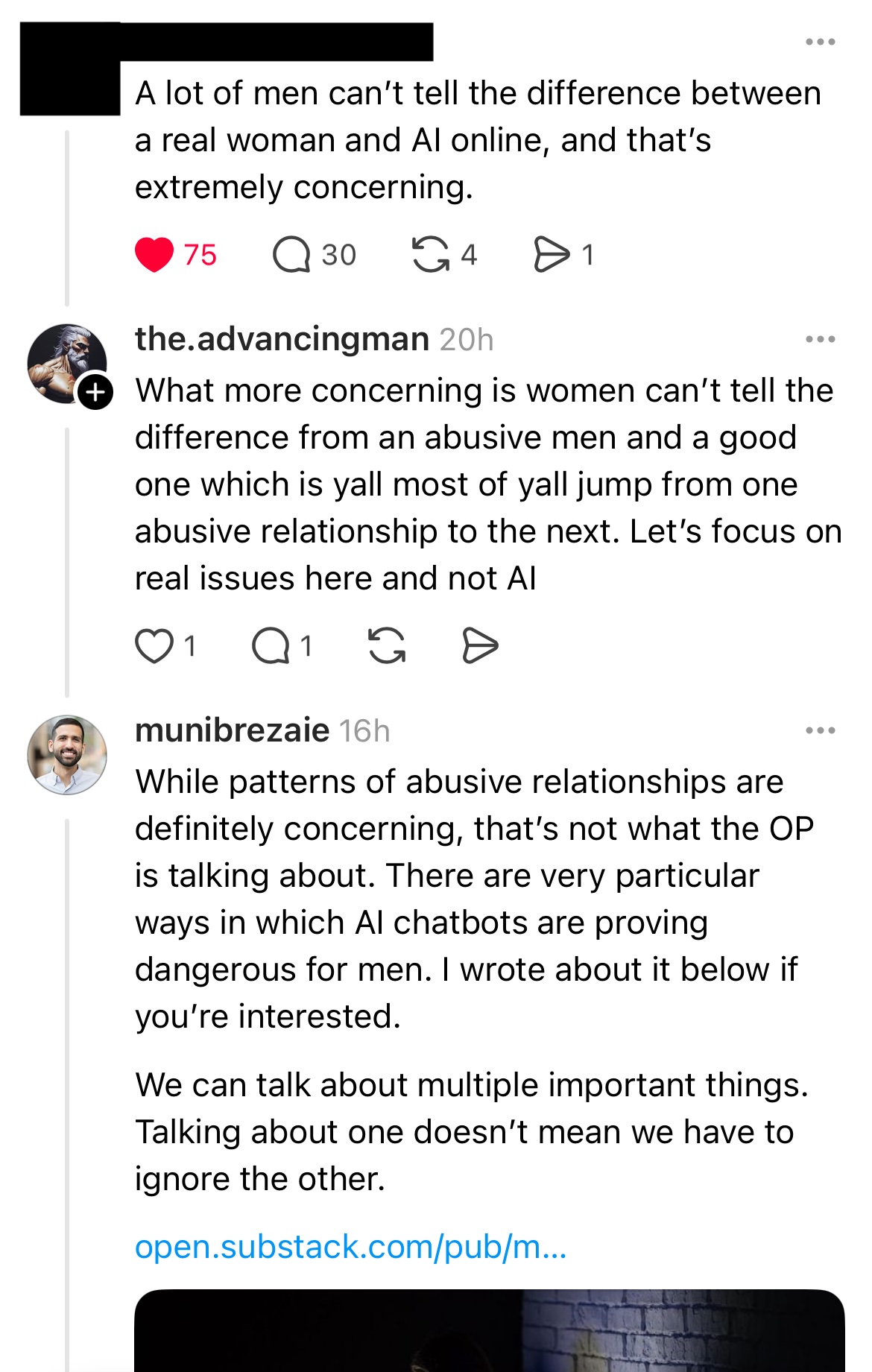
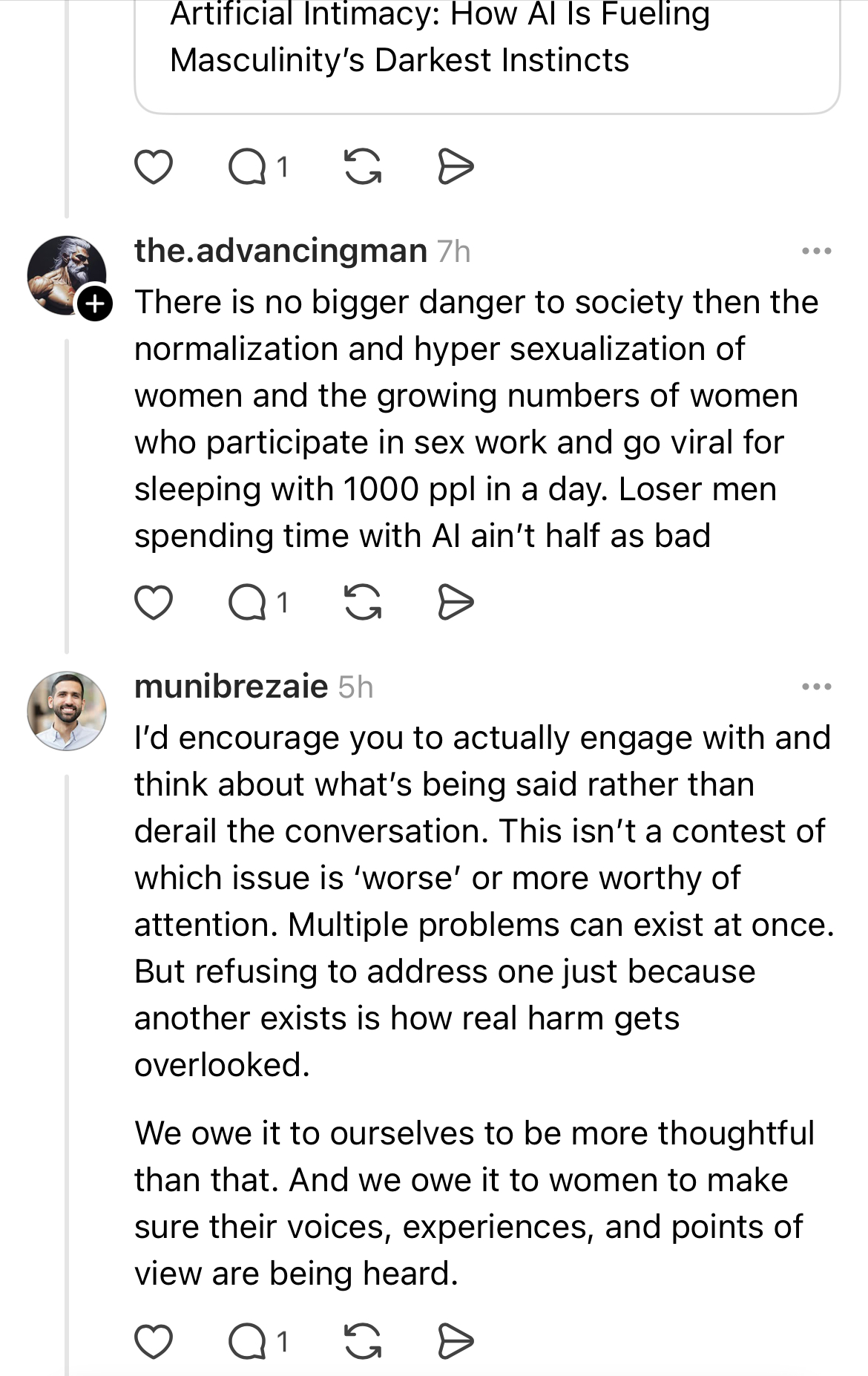

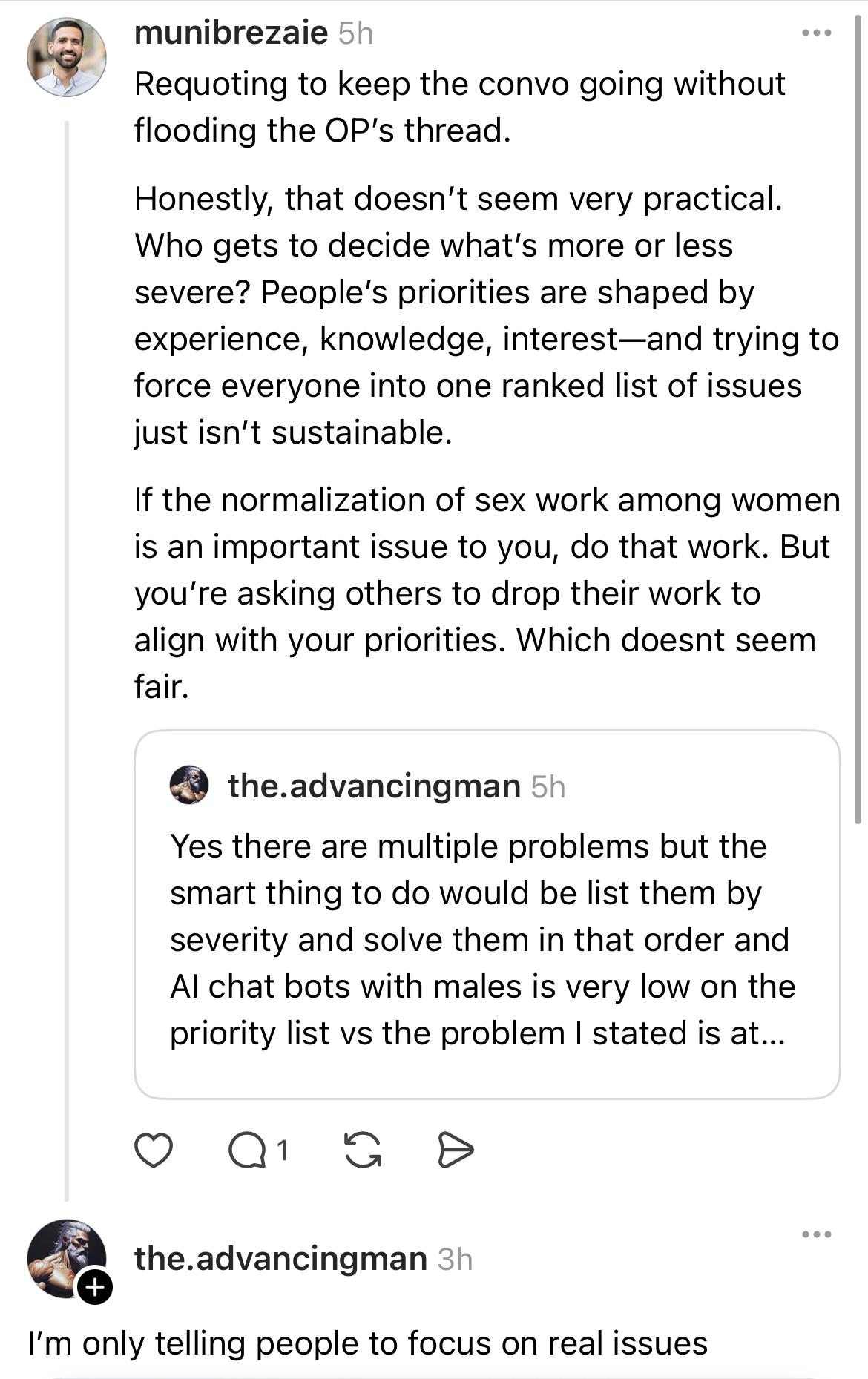
A woman posted about how concerning it is that so many men have a hard time distinguishing between a real woman and AI chatbots. A man chimed in to say that what’s more concerning is how women can’t tell abusive men apart from good men, and end up jumping from one abusive relationship to another. I replied with an attempt to direct things back to the original post, but he replied with a different point — that one of the biggest dangers to society is the hyper sexualization of women. And that women are going viral for sleeping with 1000 men. I don’t know what to tell you, y’all. I gave it one more effort after that, but he came back with a video of a man talking about how dangerous young female influencers are to our society, and I decided to leave it at that.
As you can see, I’m still learning and trying different things when it comes to how to best approach these fallacies. I’m not sure it’s actually productive, especially in online spaces, but I’m currently finding value in calling it out so that others who come across the posts might also see the fallacy at play.
Appeal to Futility
An appeal to futility, or the futility fallacy is used when someone claims that a problem isn’t worth addressing because it can’t or won’t ever be solved. It’s often used to shut down any calls for change, accountability, or progress, by acting like the issue is just too big, too complicated, or tied to an essential part of human nature that cannot be changed. I’ll admit that this last fallacy snuck up on me a little bit. As I’ve engaged more openly and frequently with people of all genders regarding issues of masculinity, I’ve been surprised by how many men – and sometimes women – make use of this fallacy.
What does this fallacy sound like?
- “You can’t teach men not to be aggressive. That’s just how we are; it’s biology.
(Invokes essentialism to shut down change efforts.) - “People are always going to be sexist/racist. Nothing we say will ever fix that.”
(Uses the existence of a problem to argue against trying to solve it.) - “There’s no point talking to women about these issues. They just hate men anyway.”
(Positions women as inherently adversarial to excuse disengagement.) - “If I speak up, it won’t matter. No one listens to men who care about these things.”
(A self-protective loop that avoids accountability by predicting failure.) - “Why should I bother being a better man when women only date bad guys anyway?”
(Tries to justify unethical behavior based on a distorted view of women’s choices.) - “Nothing’s ever good enough for feminists. Even when men try, they still get blamed.”
(Frames all critique as unfair to preemptively discredit it.) - “Men will always cheat. It’s just in our nature.”
(Excuses betrayal or harm as inevitable and unchangeable.) - “Why should I bother expressing my emotions? Women still won’t respect me for it.”
(Turns vulnerability into a trap instead of a growth opportunity.) - “You can’t stop sexual harassment. It’s just part of the real world.”
(Normalizes harm as a permanent fixture of life.) - “Changing the culture doesn’t matter; there will always be bad people.”
(Uses outliers or exceptions as a reason to stop systemic reform.)
One man online specifically told me that the only way to stop problems of sexual assault is to make sure women and men never interact with each other again. Keep them apart. That is no solution at all! At its core, this fallacy provides a perfect shield from having to reflect, change, or take any accountability, because what you’re asking is just impossible and therefore not even worth the effort!
Time and time again, the futility fallacy stops the conversation before it can even begin. It’s defeatist, and all too convenient. Because why would men want to put any kind of effort into changing something about themselves when they can just claim it as an essential and unchangeable part of who they are? This belief system allows them to avoid accountability, avoid self-reflection, and avoid having to put in the work to improve themselves.
But it’s important to remember that that is complete and utter nonsense. Men can change. Women can change. All human beings can and – I’d go so far as to say – have an inherent responsibility to change. So let’s shift the focus now from how things are playing out, to how we can start making some shifts to something better.
How to Respond Instead
Ad hominem, whataboutism, appealing to futility, and many other fallacies are often the result of similar things: someone’s defensive response to discomfort and accountability, and/or refusal to face an uncomfortable truth about themselves. Generally speaking, many boys and men do not learn how to fully name, identify, or navigate their full range of human emotions. Without that knowledge, many otherwise common everyday feelings can instead feel threatening, and discomfort is no exception.
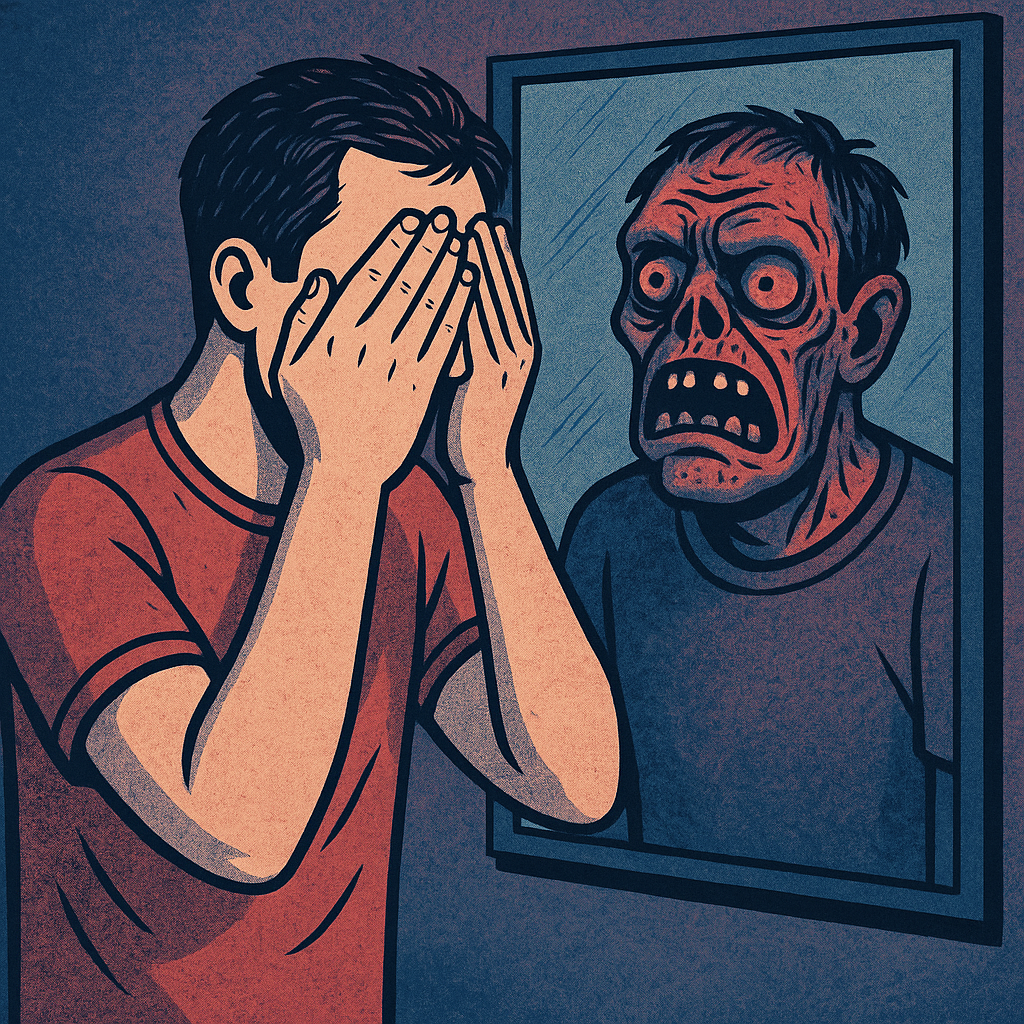
It’s not easy to be told that something you said, joked about, defended, or believe in is wrong, misinformed, harmful to others, dangerous to people you care about, misogynistic, or racist. And if you haven’t learned to sit with discomfort, your stress response will probably get triggered, making it more likely for you to lash out, get aggressive, and even double down on your problematic belief instead of admitting you were wrong, restoring things, or engaging more thoughtfully. But moments like these demand the exact opposite reaction.
So what can you do when you feel that defensive reaction bubbling up; when you’re tempted to insult, deflect, or give up? Instead of doubling down or responding with anger and fallacies, try slowing yourself down internally. Instead of aiming defensive questions outward (like ‘How dare you?’), take the opportunity to aim thoughtful ones inward so you can learn more about yourself.
Questions like:
- What am I really feeling right now, beneath the surface?
- What is it about this comment/post/video that makes me feel threatened?
- Have I really thought deeply about this topic, or just repeated what I’ve heard?
- Is it possible there’s something I don’t know about this issue?
- What ideas or beliefs am I trying to defend? Who benefits from them? Who’s harmed by them?
- Why does it feel so important that other people agree with me?
- Why does it feel so important to insult other people?
- How can I make sure I’m arguing with the ideas and not the person?
- How can I make sure my choices are in line with who I want to be?
Logical fallacies shield us from accountability. The questions above help take us towards greater and greater self-reflection, understanding, and accountability. I’m challenging you to drop the shield, to invite criticism and feedback, to stay open when you’re called out, and to model what growth can look like. That’s how you grow, not just as a man, but a human being.
I didn’t write all of this just to call other men out. I wrote this because we are ALL in urgent need of new frameworks, new ways of being, and new ways of interacting with each other. It is essential that we get away from this harmful competitive “debate” mentality that’s especially encouraged and celebrated in online spaces, and move towards striving to truly understand each other. This requires the ability to engage in genuine dialogue, the intellectual humility to know that we still have much to learn, the empathy to care for others and even put others first, and a clear moral framework to coherently live up to every day.
But we also need to see through the holes in people’s arguments, reflect on and evolve our own beliefs and ideas, and refocus conversations to make sure the heart of the matter is being addressed. Recognizing bad logic will help us create the space for better conversations, and steer them towards real change. I contribute this piece towards that goal: to help us all come to a better understanding of how harmful ideas spread, how we can take a more active role in tearing these harmful ideas apart, and take active steps towards making the world a better place.
It will take genuine, well-meaning, intentional actions from everyone – but particularly men – to dismantle the systems and patterns that help keep the manosphere afloat and women pushed down. And I absolutely believe in the capacity for men to step up to this task. Call out the fallacies! Push back on the lies! Expect better from the men around you! Be better! Do better!
What Next for Men?
If you’re a man who sees the patterns, sees the problems, wants to do better, but aren’t sure where to start, click here to check out some of my offerings. I’ve got a couple of ebooks, an online course, and a blog where I work through and offer ways to work through much of what I’ve discussed above. Or follow me on Threads, where I’m trying to put a lot of these things into practice and would love to engage in conversation about these things.
No one expects perfection. Just progress. All I’m challenging you to do is is take one small step towards breaking harmful cycles. And then another. And another. That might look like telling a friend “that’s not cool” after they make a sexist joke, leaning into vulnerability and sharing a challenge you’ve faced as a man, admitting you were wrong, journaling, self-reflecting. It might look like taking some time to intentionally come up with your values and what you want to stand for as a man.
Whatever you do, whatever step you take, remember to always stay open to learning, to growth, to being called out, and to doing better each day. Remember that you’re not doing any of this to impress anyone. You’re doing it because it’s the right thing to do. Because misogyny is real, because sexual violence is real, and because as a man and a human being on this shared planet, we have a responsibility to do our part in ensuring all people experience the safety and freedom every single one of us inherently deserves.
That’s what accountability looks like.
That’s what responsibility looks like.
That’s what empathy looks like.
That’s what real strength looks like.
That’s what it looks like to be a man.
 Munib Rezaie, PhD
Discuss!